TL;DR / At a Glance: When will the PS6 launch? Current industry data as of April 15, 2026, indicates a staggered launch strategy. The Project Canis Handheld is rumoured to arrive first in Late 2027 to bridge the gap, followed by the Project Orion (Flagship) and Project Amethyst (Lite) home consoles in November 2028. This timeline allows Sony to clear existing PS5 Pro inventory while prepping the market for a multi-device ecosystem.
Updated: 20 April 2026
As we move through 2026, the conversation has shifted from “if” to “when.” Sony is currently developing a multi-device ecosystem that fundamentally changes how we think about console generations. Moving beyond a single box under the TV, the next era of PlayStation is built on three pillars: Project Canis (Handheld), Project Orion (Flagship), and the rumored Project Amethyst (Lite).

The Triple Model Theory: PS6 Project Canis vs. Project Orion
Sony’s leaked 2026 roadmap suggests a tiered entry point into the next generation. Rather than a mid-gen “Pro” update later, Sony is reportedly launching a family of devices from day one.
| Feature | Project Canis (Handheld) | Project Orion (PS6 Flagship) | Project Amethyst (PS6 Lite) |
| Form Factor | Native Handheld | Premium Home Console | Slim Digital Console |
| Primary Goal | Native PS5 & Mobile PS6 | 4K/120fps Path Tracing | 1440p “Next-Gen” Entry |
| Memory | 24GB LPDDR5X | 30GB–40GB GDDR7 | 16GB GDDR6 |
| Estimated Price | $499 (~RM2,299) | $699 – $999 (~RM3,200) | $349 (~RM1,599) |
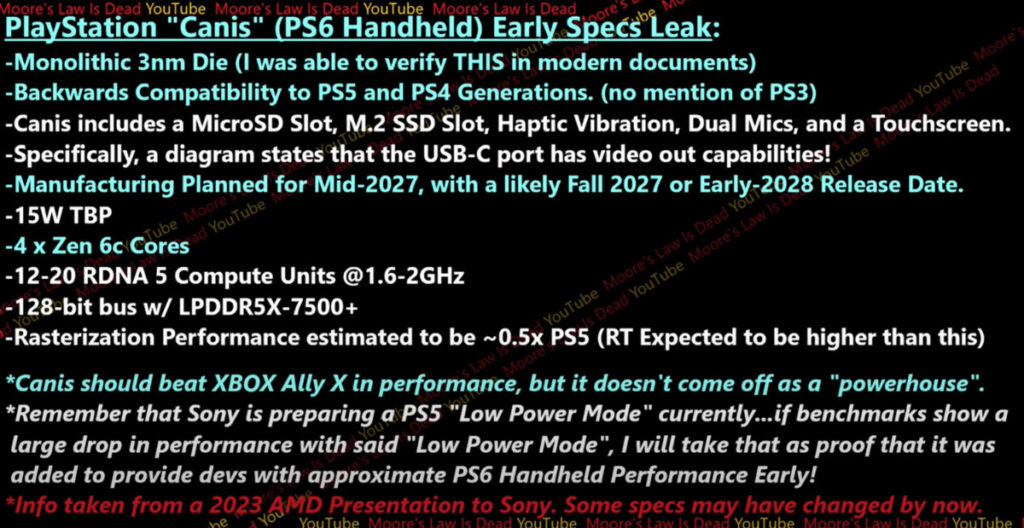
The “Tiered Silicon” Strategy: New leaks from April 15 suggest Sony is pivoting their hardware strategy to combat the global GDDR7 memory shortage. While the Orion (Flagship) will hoard the expensive GDDR7 supply for maximum bandwidth, the Amethyst (Lite) model is rumoured to use refined GDDR6. This allows Sony to hit a disruptive $349 price point, effectively making the PS6 Lite the most affordable entry into next-gen gaming history.
The “S” Factor – Why the PS6 Lite Matters
With a leaked price tag of $349 (RM 1,599), the PS6 Lite (Project Amethyst) is designed to be the “volume seller” in emerging markets like Malaysia. While it lacks the raw 8K Path Tracing power of the Orion flagship, it will utilise PSSR 2.0 (AI Upscaling) to deliver a perceived 4K experience on a budget.
For many Malaysian gamers, the choice in 2028 will likely be between the portability of Project Canis or the high-value entry of the PS6 Lite.
Latest news from the Moore’s Law is Dead podcast confirms that the PS6 Lite will feature native backward compatibility for PS4 and PS5.
Technical Deep-Dive: Zen 6 & RDNA 5
The heart of the PS6 ecosystem is the jump to the AMD Zen 6 architecture and RDNA 5 graphics. Unlike previous generations, which were incremental refinements, RDNA 5 is a “clean sheet” design specifically built for Neural Rendering and AI-driven performance.
The Move to 3nm and 2nm Nodes
- Project Canis (Handheld): Uses a monolithic 3nm die equipped with 4× Zen 6c cores for gaming and 2× Zen 6 LP cores for the OS.
- Project Orion (Flagship): Expected to utilize TSMC’s N2 (2nm) process for the primary compute chiplet, featuring 8× Zen 6c cores and up to 54 RDNA 5 Compute Units.
The AI Factor: PSSR 2.0 & Neural Texture Compression
Sony is pivoting from raw Teraflops to “Intelligent Pixels.”
- PSSR 2.0: A newly patented AI upscaler that monitors hardware load in real-time. If a scene becomes too complex, PSSR 2.0 dynamically adjusts precision to prevent frame rate drops without blurring the image.
- Radiance Cores: Dedicated hardware blocks in the GPU that handle ray traversal. This allows the PS6 to achieve 6–12x the ray-tracing performance of the PS5, enabling full Path Tracing in AAA titles.
- Neural Texture Compression: By using AI to decompress assets on the fly, Sony aims to effectively triple the perceived speed of the SSD and shrink install sizes significantly.
The Rivalry: PS6 Orion vs. Xbox Project Helix
Microsoft’s Project Helix is targeting raw power, reportedly aiming for 68 RDNA 5 Compute Units and a full Windows 11 integration.
| Metric | Sony Project Orion | Microsoft Project Helix |
| GPU Power | 34–40 TFlops (Raster) | 50+ TFlops (Raster) |
| Ray Tracing | 6–12× PS5 Performance | 20× Xbox Series X Performance |
| Unique Feature | Project Canis Handheld Integration | Native Steam & GOG Support |
Sony’s strategy is clear: focus on a refined, cohesive “Console-First” experience with a dedicated handheld, while Microsoft attempts to merge the PC and Console markets into a single high-end hybrid.
Backward Compatibility: The Legacy Block
The PS6 is designed for “Native Continuity.” Unlike the software emulation used in the past, the Orion chiplet design includes a dedicated hardware block that mimics the PS5/PS4 architecture. This ensures that your digital library moves with you at 4K/120fps from day one, with “Pro Patches” likely enhancing older titles via the new Radiance Cores.
Adam Lobo TV Real-Talk: The RAMeggedon of early 2026 is the biggest threat to these specs. If GDDR7 prices continue to climb, we might see Sony scale back from 40GB to a more conservative 30GB to keep the console under that crucial $699 price point.
This page will continuously be updated as more information becomes available.
VIA Tom’s Guide, Tweaktown, wccftech.com