Samsung Exynos 2600 Beats Snapdragon 8 Elite Gen 5 in Ray Tracing Benchmarks
TL;DR: Early benchmarks show the Samsung Exynos 2600 beating the Snapdragon 8 Elite Gen 5 by roughly 10% in ray tracing performance. The chip uses a 2nm GAA process and a new AMD RDNA 4-based Xclipse 960 GPU.
Samsung’s upcoming flagship mobile processor, the Exynos 2600, has reportedly outperformed Qualcomm’s Snapdragon 8 Elite Gen 5 in early graphics benchmarks, signalling a potential return to form for the South Korean tech giant.
According to new data from the Basemark Ray Tracing leaderboard, the Exynos 2600 secured a significant lead over its primary competitor, beating Qualcomm’s best offering by nearly 10 per cent.
Benchmark Breakdown
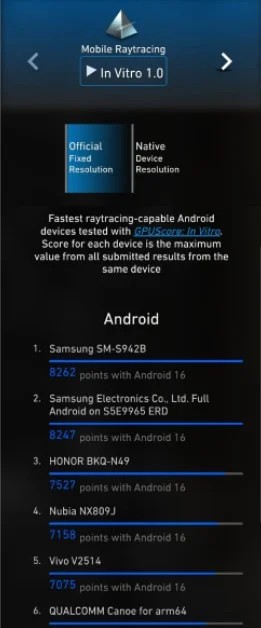
The leak highlights a device labelled SM-S942B, widely believed to be the standard Samsung Galaxy S26, achieving a score of 8,262 points. In comparison, a device identified as BKQ-N49, likely the international variant of the Honor Magic8 running the Snapdragon 8 Elite Gen 5, scored 7,527 points.
This results in a 9.76% performance advantage for the Exynos chip in this specific ray tracing test, a notable margin in the highly competitive flagship tier.
Powered by AMD RDNA 4 and 2nm Tech
The performance boost is attributed to significant architectural upgrades. The Exynos 2600 features the new Xclipse 960 GPU, which is the first mobile graphics unit to employ a customised version of AMD’s RDNA 4 architecture. This collaboration appears to be delivering a generational leap in ray tracing capabilities.
Furthermore, the chip is reportedly the first smartphone processor manufactured using Samsung’s 2nm Gate-All-Around (GAA) process. This four-sided gate transistor structure improves electrostatic control, allowing for operation at lower voltages to enhance both speed and efficiency.
Advanced Thermal Management
To sustain this performance, Samsung has also overhauled its thermal management. The chip uses fan-out wafer-level packaging (FOWLP) to reduce package size and integrates a new thermal path block (HPB). This copper heatsink makes direct contact with the application processor, reportedly reducing thermal resistance by approximately 16 per cent.
While synthetic benchmarks do not always translate perfectly to real-world usage, these early numbers suggest the Exynos 2600 could be a formidable competitor in the 2026 flagship landscape.