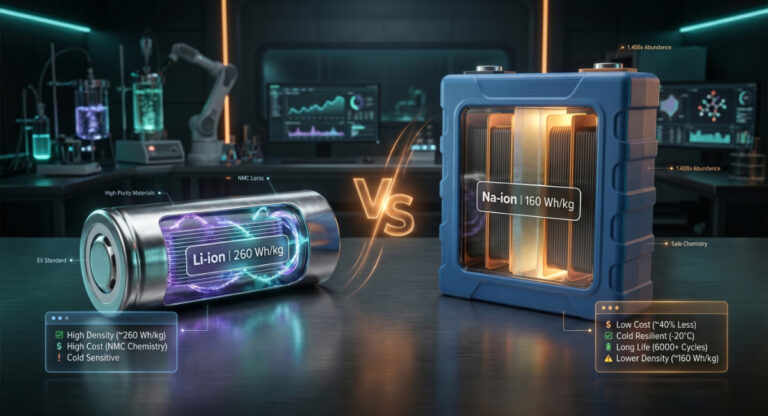
TL;DR / At a Glance: When will solid-state batteries be available? In 2026, Semi-solid-state batteries are already available in limited premium EVs like the NIO ET7, offering ranges over 1,000km. All-solid-state batteries are currently in pilot production by companies like Samsung SDI and QuantumScape, with mass-market availability for flagship smartphones and performance EVs expected between late 2027 and 2030.

While Sodium-ion is busy making budget tech affordable, Solid-State technology is preparing to blow the ceiling off what we thought was possible for premium devices. If Sodium is the “Workhorse,” Solid-State is the “Supercar.”
What is a Solid-State Battery (SSB)?
Think of a battery like a pool. In a traditional Lithium-ion battery, the “pool” is filled with a liquid chemical soup (electrolyte). Ions swim through this liquid to move energy.
In a Solid-State battery, we drain the pool and replace the liquid with a solid material—typically ceramic, glass, or a specialized polymer. The ions don’t “swim”; they move through the crystal lattice of the solid material.
How is SSB different from Lithium-ion and Sodium-ion?
The difference is entirely in the “Filling” and the “Anode.”
- Lithium-ion (The Liquid Standard): Uses liquid electrolytes and graphite anodes. It’s mature and cheap but flammable.
- Sodium-ion (The Budget Hero): Uses liquid electrolytes but replaces lithium with salt (sodium). It’s cheaper and safer in cold weather but bulkier.
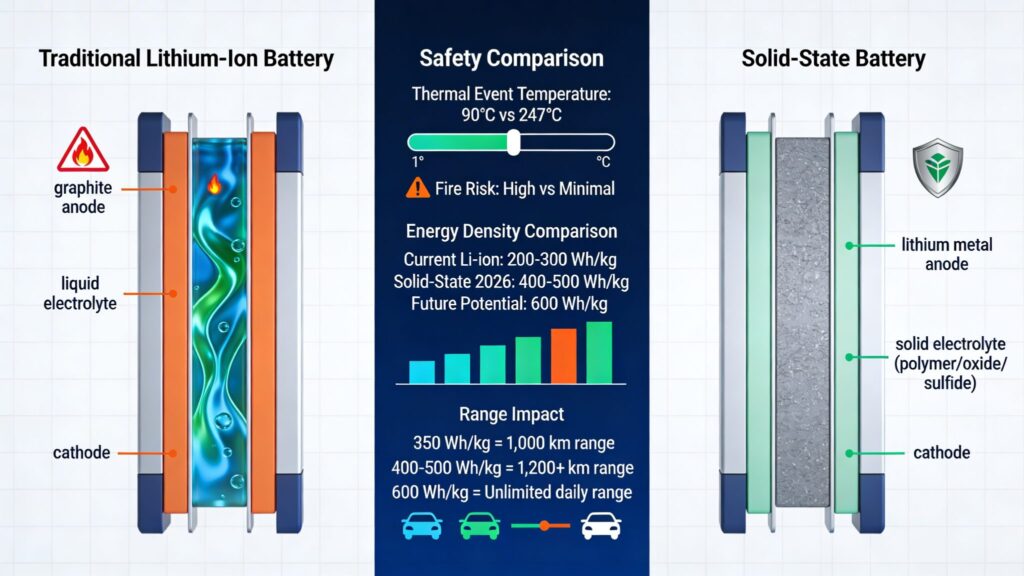
- Solid-State (The Elite Frontier): Replaces the liquid with a solid. This allows us to use a Lithium Metal Anode instead of graphite. This is the secret sauce: Lithium metal can store significantly more energy in the same footprint than graphite ever could.
Why is Solid-State better?
- Energy Density: SSBs can hit 400–500 Wh/kg. A standard Tesla or iPhone battery is around 250 Wh/kg. You’re looking at nearly double the runtime for the same weight.
- Safety: Liquid electrolytes are flammable. Solid electrolytes aren’t. You can nail-puncture a solid-state battery, and it won’t enter “thermal runaway” (catch fire).
- Charging Speed: Because they handle heat better, they can theoretically charge from 10% to 80% in under 10 minutes without damaging the battery’s lifespan.
Which devices will benefit? (Phones, Laptops, Tablets)
While EVs get the headlines, portable tech is the real winner.
- Smartphones: We are seeing the first Ultra flagships in 2026 using semi-solid cells. This allows for thinner designs (think “iPhone 18 Air”) or 3-day battery life in a standard Pro Max chassis.
- Laptops: Imagine a MacBook Air that weighs the same but lasts 30 hours on a charge.
- Wearables: As seen with the Lumia 2, solid-state allows for tiny, irregular shapes that fit inside earrings or rings without the risk of a liquid leak against your skin.
What cars have Solid-State now?
As of May 2026, we are seeing the first “commercial” deployments, mostly in China and Europe:
- NIO (ET7/ET9): Uses a 150kWh Semi-Solid pack from WeLion. It is the current range king with over 1,000km of range.
- MG (MG4 Urban / MG 4X): Launching in Europe and China this month (May 2026). It features the SolidCore semi-solid battery, focusing on safety and cold-weather performance at a more attainable price point than NIO.
- IM Motors (L6): Features a Lightyear solid-state battery with ultra-fast 900V charging.
Environmental Impact: The Hidden Win
Solid-state isn’t just about power; it’s about sustainability.
- Less Cooling, Less Waste: Because they don’t overheat easily, EVs don’t need massive, complex liquid cooling systems (heavy aluminum pipes and toxic coolants). This reduces the total material weight of the car.
- Cobalt-Free: Many solid-state designs are moving toward cobalt-free chemistries, which removes the ethical and environmental nightmare of cobalt mining in the DRC.
- Longevity: If a battery lasts 10 years instead of 5, we need to mine half as many materials over the lifetime of the device.
The 400 Wh/kg Club: Who is Winning?
To be considered a true breakthrough, solid-state needs to hit the 400-500 Wh/kg mark. Here is the leaderboard as of May 2026:
| Player | Strategy | 2026 Status |
| QuantumScape | Ceramic Separators | Launched the “Eagle Line” in San Jose; focus on industrial scaling, not just lab samples. |
| Samsung SDI | Sulfide-based Solid | Targeting mass production in H2 2027; currently sampling to BMW. |
| CATL / BYD | Multi-path Exploration | China has officially set a National Solid-State Standard for 2026 to dominate the rules of the next era. |
| Solid Power | Sulfide Electrolytes | Completed pilot cell lines with SK On in Korea and Germany. |
Emerging Trend: Batteries for “Physical AI”
One of the biggest shifts in 2026 is that Solid-State isn’t just for cars; it’s for Humanoids.
- Samsung SDI’s Breakthrough: At InterBattery 2026, Samsung SDI unveiled a pouch-type all-solid-state battery specifically for robots and wearables.
- Why it matters: Robots have zero room for bulky cooling systems. Solid-state batteries are non-flammable and ultra-compact, allowing humanoids to operate longer without the risk of a “thermal event” in your home.
The “Safety Net” for Data Centers
It’s not just about mobility. With the AI boom, data centers are drawing massive power. Samsung SDI is now marketing solid-state as a Battery Backup Unit (BBU) for AI servers. Because they don’t catch fire, these batteries can be packed much tighter inside server racks, increasing backup capacity by 50% in the same footprint.
The 2026 Reality Check: Semi-Solid vs. All-Solid
What is “Semi-Solid State”?
We are currently in the transitional Semi-Solid era (May 2026). True solid-state is hard to manufacture because solid surfaces don’t touch perfectly (imagine pressing two bricks together—there are always gaps).
Semi-solid batteries add a tiny amount of gel or liquid (about 5-10%) to “wet” the surfaces and ensure the ions can actually jump from the electrode to the electrolyte. It’s the “Hybrid” of the battery world—offering most of the safety and density of solid-state without the impossible manufacturing hurdles.
- The Pioneer: NIO has successfully deployed its 150kWh semi-solid pack, which achieved a real-world range of 1,055km in public tests.
- The Tech: It uses a gel-like polymer electrolyte. It’s safer and denser than standard liquid batteries but still acts as a bridge to the fully solid future.
- The Catch: It is expensive. Currently, the battery pack alone costs as much as a mid-range sedan (approx. €39,000 / RM185,000), making it a subscription-only luxury for now.
What about Silicon-Carbon?
In 2026, Silicon-Carbon isn’t a new category like Solid-State; it is a major upgrade to the traditional Lithium-ion batteries in your pocket. If you’ve bought a flagship phone from Honor, Xiaomi, or OnePlus in the last few months, you are likely already using it.
Here is how Si-C fits into the battery hierarchy and why it is the most important “right now” technology.
Every battery has two sides: a cathode (+) and an anode (-). For 30 years, anodes have been made of Graphite.
- The Problem: Graphite is like a small locker—it can only hold so many lithium ions.
- The Solution: Silicon can hold 10 times more lithium ions than graphite.
- The “Carbon” Part: Pure silicon is volatile; it expands like a balloon (up to 300%) when charging, which used to make batteries explode or crack. By wrapping the silicon in a Carbon scaffold, engineers have finally “caged” the silicon, allowing it to expand safely.
Is it the same as Semi-Solid State?
No. They are two different parts of the battery “sandwich.”
- Silicon-Carbon is about the Anode (the “Bread”). It increases how much power you can pack into the battery.
- Semi-Solid State is about the Electrolyte (the “Filling”). It increases safety and charging stability.
The 2026 Trend: The most elite devices are now combining both. They use a Silicon-Carbon Anode (for massive capacity) with a Semi-Solid Electrolyte (for safety and slimness).
Silicon-Carbon vs. The Others
| Feature | Lithium-ion (Graphite) | Silicon-Carbon (Si-C) | Solid-State (SSB) |
| Status | Legacy / Standard | 2026 Flagship Standard | Prototype / Luxury |
| Capacity | Baseline (5,000mAh) | +20-40% (6,500mAh+) | +100% (10,000mAh+) |
| Thickness | Standard | Ultra-Thin | Thinnest |
| Charging | Fast | Ultra-Fast (80W-120W) | Instant (under 10 mins) |
| Cost | Cheapest | Medium (+20%) | Very High |
Why Silicon-Carbon is the “Foldable Saviour”
If you’ve wondered how the Honor Magic V3 or Oppo Find N6 can be so thin yet have massive batteries, Silicon-Carbon is the answer.
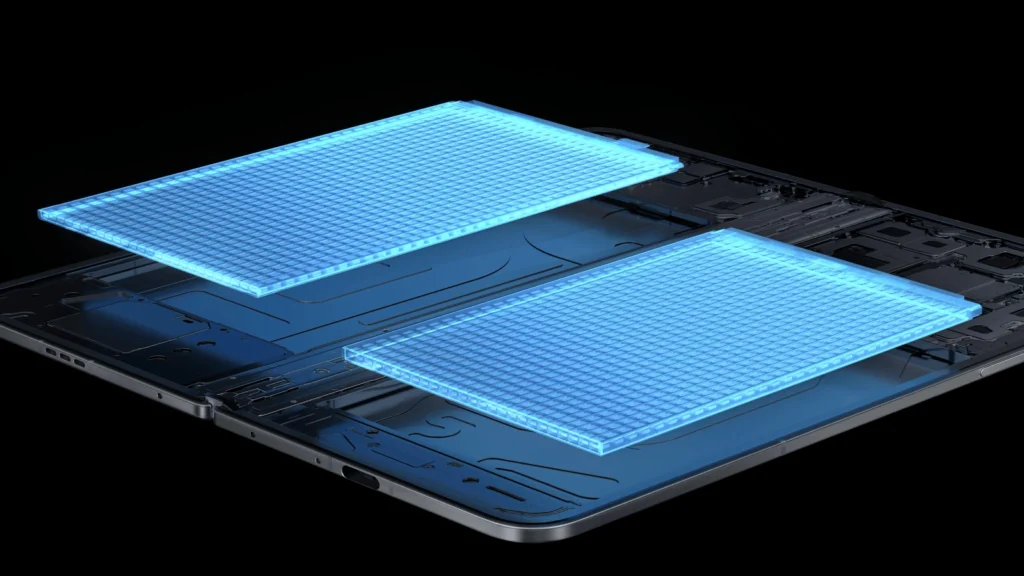
- Because Si-C is much denser, manufacturers can make the battery thinner than a credit card while still offering 5,000mAh+.
- The “Watch First, Buy Smart” takeaway: In 2026, if a phone has a battery larger than 5,500mAh but doesn’t feel like a brick, it’s using Silicon-Carbon.
Real-World 2026 Devices using Si-C
- Honor Magic V6 / V7: Uses “Qinghai Lake” (3rd Gen Si-C) to hit nearly 8,000mAh in a foldable.
- Xiaomi 17 Ultra: Uses a Si-C “Cobalt-Free” battery for 6,500mAh.
- OnePlus 15 / 16: Features “Glacier Battery” tech (Si-C) for multi-day battery life in a slim candy-bar design.
The 2026 Battery Hierarchy
| Technology | The “Role” | Key Advantage | The “Catch” |
| Lithium-Ion (Li-ion) | The Veteran | Mature, cheapest per Wh, standardized. | Flammable; hit a “ceiling” in density. |
| Sodium-Ion (Na-ion) | The Budget Hero | ~30% cheaper; massive cold-weather stability. | Heavier/Bulkier; lower range for EVs. |
| Silicon-Carbon (Si-C) | The Turbocharger | 10x anode capacity; ultra-thin designs. | Higher cost; complex to manufacture. |
| Semi-Solid State | The Bridge | Safe, 1,000km range, 2026’s “Elite” tech. | Still high cost; mostly for premium EVs. |
| Solid-State (SSB) | The Holy Grail | Double density (500 Wh/kg); virtually fireproof. | High-scale production still 2-4 years away. |
Silicon-Carbon vs. Lithium-Ion
The “Right Now” Upgrade. In 2026, Silicon-Carbon is the most important technology for smartphones. It is an internal upgrade to Lithium-ion.
- The Difference: Traditional Li-ion uses a graphite anode (the “Bread”). Silicon-Carbon replaces it with a silicon-infused anode that can hold significantly more ions.
- The Result: This is how we get 6,000mAh batteries in phones that are thinner than 8mm.
- Verdict: If you’re buying a flagship phone in 2026, Si-C is a must.
Sodium-Ion vs. Lithium-Ion
The Economics Play. This isn’t about better performance; it’s about sustainability and cost.
- The Difference: Replaces expensive Lithium with common Salt (Sodium).
- The Result: It doesn’t catch fire easily and works at -20°C without losing 40% of its range like Lithium does.
- Verdict: Perfect for budget phones, two-wheelers, and grid storage. It keeps tech prices low despite the “AI Tax.”
Semi-Solid vs. Full Solid-State
The Performance Play. This is where the 1,000km EV range comes from.
- The Difference: Traditional batteries use a liquid electrolyte. Full Solid-State uses a solid ceramic or glass block. Semi-Solid uses a gel or slurry to bridge the gap.
- The Result: Semi-Solid is what we see in the NIO ET9 and MG4 Anxin Edition in 2026. It offers nearly the same safety and density as full solid-state but is actually manufacturable today.
- Verdict: This is for the Elite segment—luxury EVs, high-end drones, and professional robotics.