Lasers, Titanium dust, and the End of Waste: Apple’s Quiet Manufacturing Revolution
In a nondescript facility, rows of white machines rise from the floor like miniature skyscrapers. Inside, there is no clamour of heavy machinery striking metal. Instead, there is only the silent, precise dance of lasers fusing titanium dust into solid form.
Apple has officially confirmed a significant shift in its manufacturing pipeline: for the first time, the entire production run of the Apple Watch Ultra 3 and the titanium Apple Watch Series 11 cases is being created using 3D printing technology.
It is a move that Kate Bergeron, Apple’s Vice President of Product Design, describes as “an idea that wanted to become a reality.”
The Death of “Subtractive” Manufacturing

For decades, high-end metal electronics were born from a process of subtraction. Manufacturers would start with a solid slab of metal and cut away everything that wasn’t the device, turning vast amounts of premium alloy into scrap.
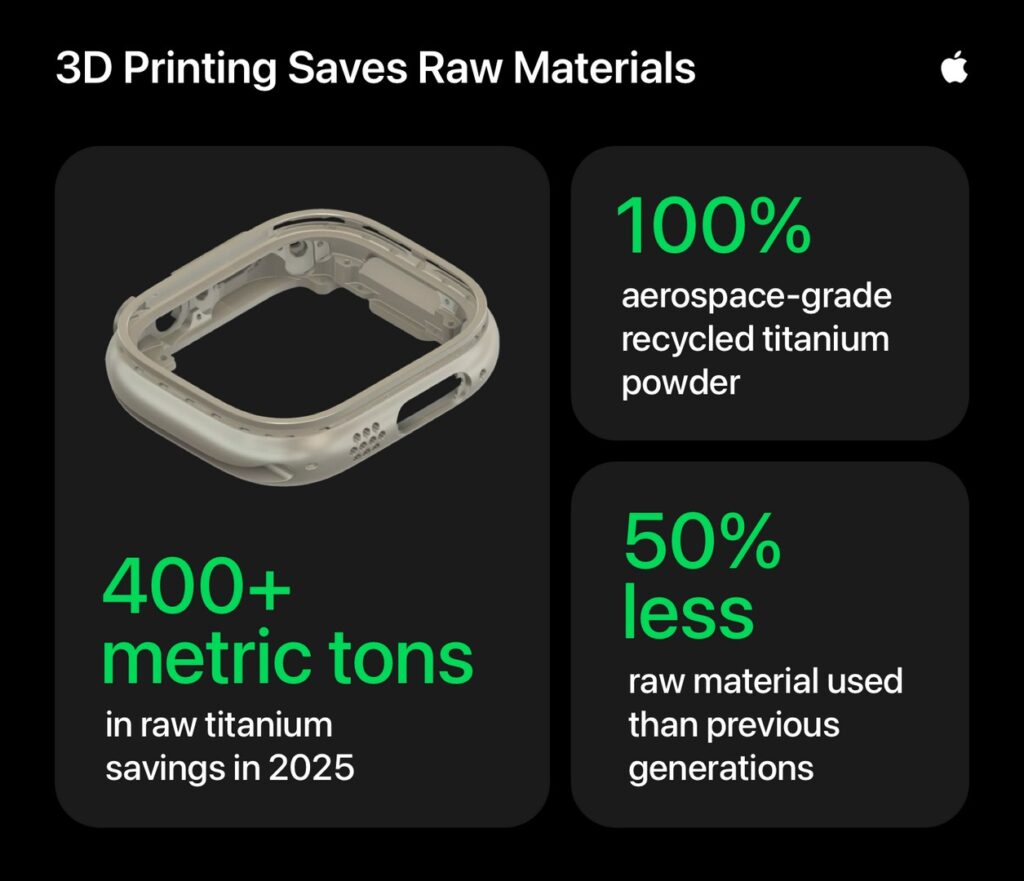
The new process reverses this entirely. Using “additive” manufacturing, Apple’s latest machines use six distinct lasers to build the watch cases layer by layer, over 900 layers in total, from a bed of 100% recycled aerospace-grade titanium powder.
The impact is immediate and massive. By printing only the metal that is needed, Apple has cut raw material usage by 50%.
“A 50 percent drop is a massive achievement—you’re getting two watches out of the same amount of material used for one,” explains Sarah Chandler, Apple’s VP of Environment and Supply Chain Innovation. “When you start mapping that back, the savings to the planet are tremendous.”
The company estimates this shift alone will save over 400 metric tonnes of raw titanium in just one year.
Controlling the Powder
The transition wasn’t as simple as buying off-the-shelf printers. Titanium is notoriously difficult to work with; it becomes explosive when exposed to heat if the oxygen content isn’t perfectly managed.
“This was cutting-edge materials science,” Bergeron notes. The teams had to refine the titanium powder to a diameter of 50 microns—essentially the consistency of fine sand—and engineer a way to keep oxygen levels low enough to prevent volatile reactions while high-powered lasers fused the metal.
The resulting parts aren’t just environmentally friendly; they are structurally distinct. The 3D printing process allowed Apple to print microscopic textures on the inner surfaces of the case that were previously impossible to forge. These textures bond better with the plastic antenna housing, improving water resistance for cellular models.
Beyond the Watch
While the Apple Watch is the headline, the technology is already bleeding into other product lines. Apple revealed that the USB-C port on the new iPhone Air is also protected by a 3D-printed titanium enclosure.
This signals that 3D printing at Apple is no longer a niche prototyping tool; it is becoming the backbone of their mass production.
“We’re never doing something just to do it once—we’re doing it so it becomes the way the whole system then works,” says Chandler.
As the white “Lego skyscraper” printers whir day and night, they aren’t just building watches. They are printing a roadmap for a manufacturing future where waste is obsolete and the factory floor is as quiet as a library.