TL;DR / At a Glance: The Acer Aspire Go 15 and the Apple MacBook Neo represent a major generational shift toward highly efficient, phone-derived ARM architectures in the budget laptop market. While the MacBook Neo leverages binned A18 Pro silicon to command clear compute, graphics, and native NPU execution advantages, it sits at a premium $599 price point. Conversely, the Acer Aspire Go 15 utilises Qualcomm’s Snapdragon C platform to deliver a 100% fanless, silent Windows workspace featuring a larger 15.6-inch display and an expanded 53Wh battery cell for exactly half the price at a target $300 floor.
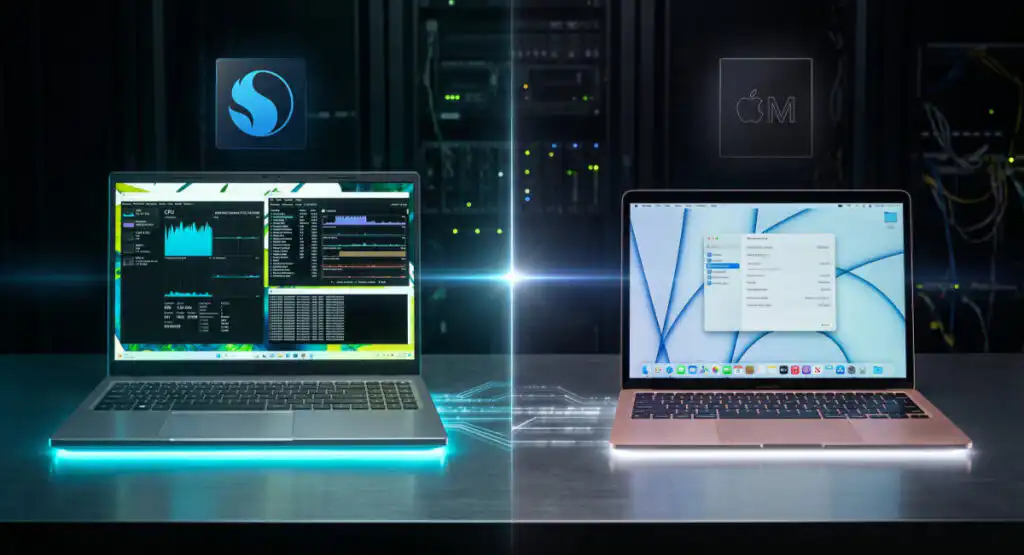
The $300 ARM Battleground: Acer Aspire Go 15 vs. Apple MacBook Neo
Until Qualcomm announced the Snapdragon C platform, Apple’s budget strategy with the MacBook Neo went completely unanswered. Apple essentially created a brand-new segment by pulling binned A18 Pro smartphone chips off their assembly lines, dropping them into a premium 13-inch aluminum shell, and pricing it aggressively at $599 (RM2,499 in Malaysia) to capture students and casual users.
As we noted in our exclusive launch coverage of the Acer Aspire Go 15, this new machine is the PC ecosystem’s first direct shield against Apple’s budget monopoly. But mechanically, these two machines attack the entry-level space from two radically different angles. Let’s slice directly through the marketing noise and look at the unvarnished reality of what you are actually paying for.
Budget ARM Performance Showdown
| Feature Parameter | Acer Aspire Go 15 (AG15-Q31P) | Apple MacBook Neo (2026) |
| Official Retail Price | Targeting ~$300+ (Approx. RM1,190+) | Starts at $599 (RM2,499 in Malaysia) |
| Silicon Architecture | Qualcomm Snapdragon C (ARM Layout) | Apple A18 Pro (Phone-Derived ARM) |
| Compute Power (CPU) | Kryo big.LITTLE mobile core design clusters | 6-Core CPU (2 Performance / 4 Efficiency) |
| Graphics Engine (GPU) | Integrated Qualcomm Adreno Graphics | 5-Core Binned Apple GPU (Ray Tracing) |
| NPU AI Capabilities | Integrated hardware NPU for daily tasks | 16-Core Apple Neural Engine |
| Memory & Storage | Up to 8 GB memory / 512 GB storage | Fixed 8GB Unified RAM / 256GB or 512GB SSD |
| Screen Specifications | 15.6-inch Full HD Display (1920×1080) | 13.0-inch Liquid Retina (2408×1506, 500 nits) |
| Battery Life Target | All-Day Endurance (53 Wh battery footprint) | Up to 16 hours video / 11 hours wireless web |
| Cooling & Fan Noise | 100% Fanless / Completely Silent | Fanless / Completely Silent |
| Operating System | Windows 11 Home | macOS Tahoe (With Apple Intelligence support) |
The Structural Differences Broken Down
1. Compute Power (CPU)
The MacBook Neo pulls ahead significantly in raw, single-core snappiness. Apple’s A18 Pro utilises desktop-class IPC instruction design adapted for mobile. It deals with daily single-threaded apps with near-zero latency, though it runs notoriously hot under continuous multi-core processing layouts because it lacks active cooling.
The Acer Aspire Go 15 uses a much more conservative smartphone-derived Kryo architecture layout. It is built strictly for value, optimising web browsing, productivity, and document typing. It won’t match Apple in raw benchmarks, but it scales its workloads perfectly to keep your device completely cool to the touch.
2. Graphics + NPU Power
This is a clean victory for Cupertino. The Neo’s binned 5-core GPU features hardware-accelerated ray tracing. It handles modern casual games and graphics reconstruction far better than standard budget machines. Furthermore, its 16-core Neural Engine runs native on-device Apple Intelligence frameworks seamlessly.
Acer’s Snapdragon C features an integrated NPU built to handle everyday AI tasks like automatic background blur, transcription, and live captions, but it possesses a lower overall processing floor. It does not meet the strict requirements for Microsoft’s premium Copilot+ certification.
3. Battery Life & Endurance
Both of these devices represent a massive, generation-defining middle finger to old, power-hungry x86 budget laptops. Because both run on highly efficient ARM processor pipelines, they minimize standby idle power drain near-zero.
The MacBook Neo runs on a 36.5Wh battery that yields roughly 11 hours of active wireless web usage. Acer combats this by leveraging its larger chassis to jam a much larger 53Wh battery cell inside the frame. When paired with the lower-clocked power targets of the Snapdragon C platform, Acer is gunning for absolute multi-day class endurance.
4. Cost & Affordability
This is where Acer completely breaks the market open. While Apple’s $599 MacBook Neo is cheap for an Apple product, it still translates to roughly RM2,499 locally—stretching past what an average family or student looking for a basic laptop wants to spend. At a target price floor of $300 (approx. RM1,190), Acer is providing a true legacy-free, fanless, modern connected workspace device for exactly half the price of entry into Apple’s ecosystem.
Other Little Things
1. The Screen Size Reality
Beyond the internal components, the physical viewing experience is drastically different. Apple sticks to a highly compact 13-inch frame for portability, while Acer pushes a massive 15.6-inch display. This makes the Aspire Go 15 a much better stationary desktop-replacement option for families who require split-screen multi-tasking without connecting to an external monitor.
2. The OS Ecosystem Divide
The choice here heavily dictates your software freedom. The MacBook Neo locks you cleanly into macOS Tahoe and its walled app ecosystem. The Aspire Go 15 runs Windows 11 Home natively on ARM but is also heavily tipped to natively support Google’s upcoming Googlebook platform—an AI-native Android-desktop hybrid launching this fall that could change the budget computing game entirely.
3. RAM Upgradability Limits
To hit these ultra-low entry-level price brackets, both manufacturers have implemented hardware limits. Apple permanently solders their 8GB unified memory block onto the A18 package, and Acer locks the Aspire Go 15 to a strict 8GB system ceiling to match the constraints of the Snapdragon C architecture. Neither machine can be upgraded down the line, so manage your multitasking expectations accordingly.
The Verdict: Price vs. Prestige
If you have RM2,500 to spend and your workflow revolves around heavy single-core processing, raw graphics performance, and the premium status of an aluminum build, the Apple MacBook Neo remains an uncontested masterpiece.
But if you are on a strict budget, the Acer Aspire Go 15 is an absolute revelation. For exactly half the price, it delivers a massive 15.6-inch screen, dead-silent fanless computing, a larger physical battery, and modern USB-C connectivity. Qualcomm and Acer have officially democratised ARM computing, making sure that cash-strapped families no longer have to settle for slow, noisy hardware.
Frequently Asked Questions about the Acer Aspire Go 15 (Snapdragon C)
Is the Acer Aspire Go 15 faster than the Apple MacBook Neo?
No. The Apple MacBook Neo utilises the binned A18 Pro system-on-chip, which commands a distinct single-core compute and graphics performance advantage over the entry-tier smartphone-derived Kryo architecture found inside the Acer Aspire Go 15.
How do the prices of the Aspire Go 15 and MacBook Neo compare in Malaysia?
The Apple MacBook Neo officially retails starting at $599 (approx. RM2,499 locally). While final regional tracking for the Acer Aspire Go 15 is still pending, its target global pricing floor sits at $300 (approx. RM1,190), making it exactly half the price of entry into Apple’s laptop ecosystem.
Which laptop has a larger screen and a bigger battery cell?
The Acer Aspire Go 15 wins on pure footprint scale, housing a large 15.6-inch Full HD screen and an expanded 53Wh battery cell. The Apple MacBook Neo opts for maximum portability with a smaller 13-inch Liquid Retina panel backed by a 36. Wh battery array.