
TL;DR / At a Glance: Google has launched Gemini 3.5 Flash and Gemini Spark at Google I/O 2026, shifting the AI paradigm from passive text generation to autonomous execution. Gemini 3.5 Flash operates four times faster than rival frontier models and outperforms legacy premium models like Gemini 3.1 Pro in coding and multi-step agentic workflows. Utilising this high-speed architecture alongside Google’s Antigravity framework, Gemini Spark operates as a cloud-hosted, 24/7 personal assistant that executes long-horizon tasks across Google Workspace entirely in the background, even when user devices are completely powered down.
Let us be completely real about the current state of artificial intelligence. Up until right now, AI has essentially been a glorious, reactive party trick. You type a prompt, you wait a few seconds, it spits out text, and then it sits there completely frozen until you give it another instruction. It is a passive digital paperweight.
At the annual Google I/O 2026 developer conference, Google officially declared the passive chatbot era dead.
With the simultaneous introduction of Gemini 3.5 Flash and Gemini Spark, the tech giant has fundamentally re-engineered artificial intelligence into a proactive workforce. We are no longer talking about generative writing tools; we are talking about autonomous digital agents that execute highly complex, multi-day operations entirely behind the scenes.
Gemini 3.5 Flash: The Speed Demon That Inverted the Hierarchy
Historically, the AI model hierarchy has been painfully predictable: “Pro” models give you premium intelligence at a slow, expensive crawl, while “Flash” models give you cheap, lightning-fast responses with a noticeable drop in cognitive quality.
Gemini 3.5 Flash completely shatters that dynamic.
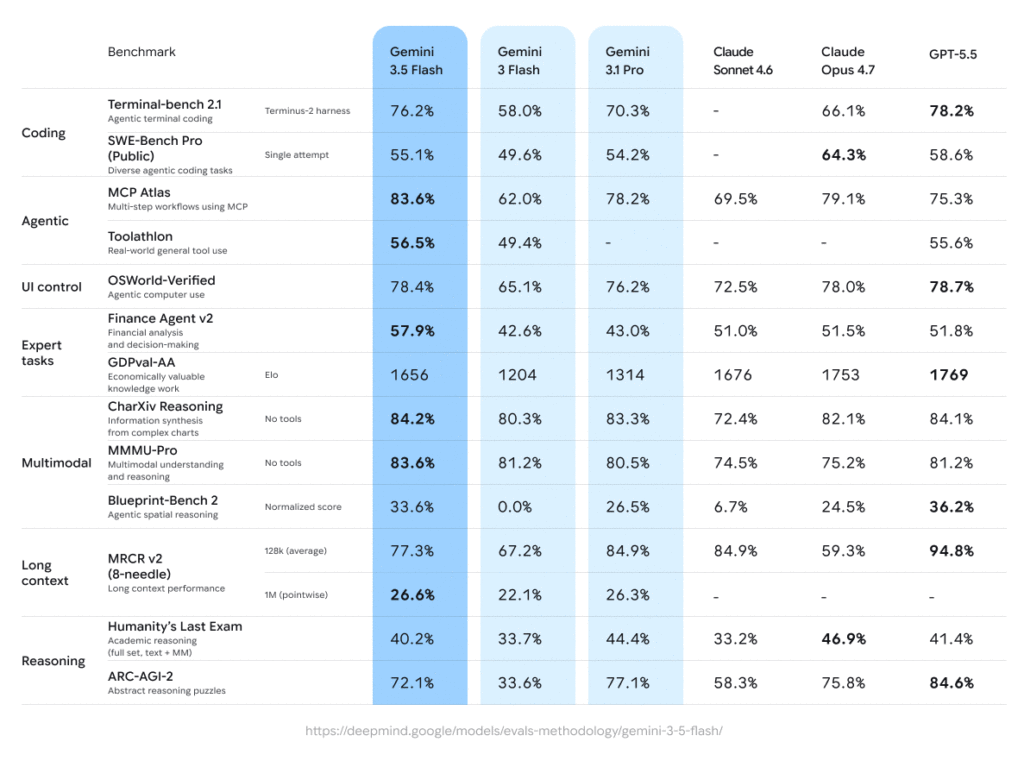
This model is Google’s fastest agentic architecture ever built, operating an incredible four times faster on output tokens per second than any competing frontier model on the market. But the real shockwave is its capability profile. Gemini 3.5 Flash actually outperforms Gemini 3.1 Pro on coding and multi-step agentic benchmarks.
It holds a commanding lead on tool-use evaluations, scoring an impressive 76.2% on Terminal-Bench 2.1 and dominating visual reasoning frameworks. Google accomplished this by baking “thinking levels” directly into the core engine. The model preserves its intermediate reasoning chains across multi-turn conversations automatically. It doesn’t just guess the next word; it actively calculates its execution path before writing a single line of code.
Gemini Spark: Your 24/7 Cloud-Hosted Employee
If Gemini 3.5 Flash is the high-performance engine, Gemini Spark is the fully autonomous vehicle that uses it.
Gemini Spark is a 24/7 personal AI agent embedded directly inside the Gemini app ecosystem. Do not mistake this for a standard macro or a basic software integration like a custom GPT. Spark does not run locally on your phone or computer. Instead, it provisions itself on dedicated Google Cloud virtual machines.
This structural design choice introduces a massive shift in utility: Gemini Spark keeps working even when your device is completely turned off.
You can literally offload a complex project to Spark, shut down your laptop, lock your phone, and head out for the weekend. Running on Google’s advanced Antigravity orchestration framework, Spark can deploy dozens of specialized parallel “sub-agents” to coordinate long-horizon workflows across your entire Google Workspace infrastructure.
The Mamak Test: Real-World Long-Horizon Automation
Imagine sitting at your favourite local spot in Kuala Lumpur, enjoying a cold glass of Milo ais. You receive a massive, messy data dump of client expense invoices, conflicting calendar requests, and chaotic project briefs via email.
In the old paradigm, you would spend your afternoon stuck staring at your screen, copy-pasting text back and forth into a chatbot window, correcting its errors step-by-step.
With Gemini Spark, you simply open your mouth and delegate the entire operational workflow before pocketing your phone:
“Spark, go through my unread project emails from the last 48 hours. Cross-reference the attached invoices with our master budget sheet in Google Sheets, flag any discrepancies over RM500, compile the final data into a polished presentation slide deck, and draft a summary email to the management team ready for my review by Monday morning.”
You close the app. Your phone goes into standby mode. While you are busy eating dinner, Spark is spinning up virtual environments in the cloud, autonomously executing iterative debugging cycles, managing schedules, and organising complex datasets. If it encounters a highly sensitive data action, it cleanly pauses to ping your phone for a one-tap security permission, then dives right back into the background grid to finish the job.
The Developer Shift: The Reality of the “Thinking” Surface
For the developers and architects building local applications in Southeast Asia, the release of Gemini 3.5 Flash brings a critical structural update to Google AI Studio and Android Studio.
Google has officially retired the old thinking_budget variable and replaced it with a strictly enforced thinking_level string parameter (featuring minimal, low, medium, and high configurations).
Crucially, the default out-of-the-box effort level has been set to medium to optimise global latency and API cost structures. If you are migrating legacy code straight from the older Gemini 3 Flash previews, you must explicitly opt back into the high thinking tier, or your application will silently execute fewer background reasoning cycles than your initial prototypes did.
Adam’s Take: The Agentic Landgrab
With Gemini 3.5 Flash shipping globally and Gemini Spark rolling out its beta access directly to consumer Google AI Ultra subscribers, Google has executed a masterful chess move. They have recognised that the tech community is completely fatigued by simple text entry bars.
By building an architecture that marries unprecedented computing speed with self-sustaining cloud execution, Google is moving aggressively to lock down users before competitors can deploy their own infrastructure frameworks. The era of chatting with your artificial intelligence is over—the era of managing your autonomous AI workforce has officially begun.