
TL;DR / At a Glance: Unveiled during Jensen Huang’s Computex 2026 GTC keynote, the NVIDIA RTX Spark (Silicon Code: N1X) is a monolithic System-on-Chip co-developed with MediaTek on TSMC’s 3nm process node. Engineered to break Qualcomm’s hold on the Windows on ARM ecosystem and directly challenge Apple Silicon’s unified memory structure, the Spark packs a 20-core ARM Grace CPU alongside an integrated Blackwell GPU boasting 6,144 CUDA cores and a 1 Petaflop FP4 local AI compute engine. Crucially, the platform bypasses the historical ARM gaming bottleneck by engineering a native runtime layer for kernel-level anti-cheat engines (Easy Anti-Cheat, BattlEye). However, severe global LPDDR5X supply constraints position the maximum 128GB unified memory configuration as an ultra-premium halo tier, commanding an expected Malaysian retail price threshold between RM18,000 and RM21,000.
The tech world is suffering from chronic, exhausting AI feature fatigue. We have spent the last year being bombarded by hardware brands claiming that basic cloud-based text summarisation, AI photo filters, and dedicated keyboard buttons are worth upgrading your hardware for. They aren’t. Consumers have completely checked out because the utility-to-cost ratio of early “AI PCs” has been utterly depressing.
But during his opening GTC Keynote at Computex 2026, NVIDIA CEO Jensen Huang did something that completely shattered the corporate narrative.
NVIDIA didn’t just drop another generic processor refresh; they threw a high-performance grenade into the mobile industry. Say hello to the NVIDIA RTX Spark (Silicon Code: N1X). Developed in lockstep with MediaTek on TSMC’s bleeding-edge 3nm process node, this monolithic, ultra-thin System-on-Chip (SoC) is designed to systematically dismantle Qualcomm’s temporary monopoly on the Windows on ARM ecosystem and challenge Apple Silicon’s structural dominance. Let’s take a deep dive into the silicon reality behind this launch.
The Architecture Unmasked: Shifting to Agentic OS
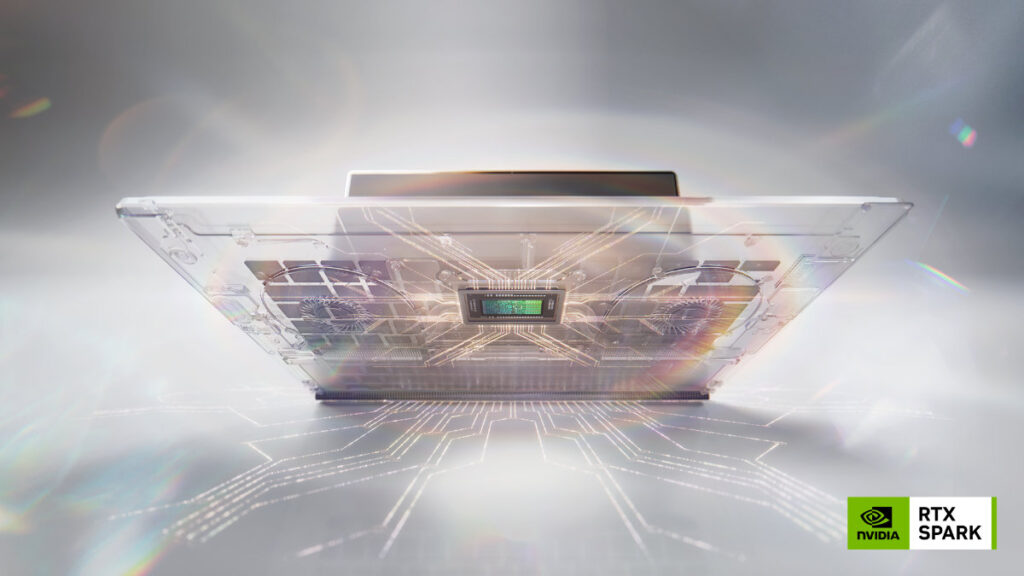
The RTX Spark is a radical departure from traditional multi-chip notebook layouts. Instead of separating the processor and graphics card across a wide, power-hungry motherboard, NVIDIA has consolidated the entire computing stack onto a single piece of 3nm silicon (hmm, where have we seen this before, eh?).
NVIDIA RTX Spark (N1X) Architecture Profile
| Hardware Parameter | Technical Specification Metric |
| CPU Core Complex | 20-Core ARM Grace Architecture (10 Performance + 10 Efficiency) |
| iGPU Core Density | Monolithic Blackwell Architecture (6,144 CUDA Cores) |
| On-Device AI Engine | 1 Petaflop FP4 Local Compute Canvas |
| Memory Subsystem | 16-Channel LPDDR5X Unified Bus Structure |
| Max Memory Allotment | Up to 128GB Unified Footprint |
| Interconnect Architecture | On-Die NVLink-C2C (Zero Inter-Die Translation Latency) |
| Dynamic Power Range | 45W – 80W Scaling Thermal Envelope |
Why does that 1 Petaflop FP4 local compute canvas matter? Because NVIDIA is entirely bypassing basic AI productivity tasks to shift the industry toward an Agentic Operating System.
The RTX Spark is built to continuously run multi-step, autonomous local AI agents (such as OpenClaw and Hermes) directly in the background, 24/7. These digital agents operate completely on-device without ever contacting an external cloud server. They can autonomously index your local files, cross-reference data arrays, organise massive file structures, and execute complex business workflows completely offline, maintaining absolute corporate data privacy while running smoothly on battery power.
| Platform Architecture | CPU Core Complex | Interconnect Pathway | Graphics Engine | Memory Pipeline Reality |
| Traditional x86 PC | Standard x86 Processor | Slow PCIe Gen 5 Motherboard Lanes | Discrete Mobile GPU | Data must travel across physical board traces to swap between System RAM and GPU VRAM, creating a severe latency bottleneck. |
| NVIDIA RTX Spark (N1X) | ARM Grace CPU | On-Die NVLink-C2C (300GB/s) | Monolithic Blackwell GPU | Both processing blocks sit on a single 3nm die, sharing direct, simultaneous access to a massive unified memory footprint. |
For five years, Apple’s unified memory architecture has made the MacBook Pro line the undisputed king for local Large Language Model (LLM) developers and high-end creative editors. Traditional x86 laptops are fundamentally bottlenecked because data must travel across slow physical motherboard PCIe lanes from the system RAM to a discrete graphics card’s dedicated VRAM.
The N1X completely changes the rules of the fight. By linking the ARM Grace CPU complex and the massive Blackwell GPU via an on-die NVLink-C2C interconnect sharing up to 128GB of LPDDR5X unified memory, NVIDIA hits an astonishing 300GB/s bandwidth pipeline. For the first time ever, a mobile Windows machine can natively run dense, 120-billion-parameter local AI models with up to a 1-million-token context window completely untethered from a wall outlet. It is a direct tactical threat to Apple’s luxury creator base.
Smuggling Kernel Anti-Cheat Onto ARM
The absolute fatal flaw of existing Windows on ARM laptops—specifically Qualcomm’s Snapdragon X Elite and X2 lines—has been its complete inability to function as a competitive gaming machine. The core issue wasn’t the raw performance of Qualcomm’s Adreno graphics drivers; it was a fundamental security architecture wall.
High-tier competitive multiplayer PC games rely on kernel-level anti-cheat software to protect competitive integrity. Because these anti-cheat engines embed themselves deeply within the low-level x86 Windows kernel structure, they actively block software translation layers. If you attempt to boot competitive staples like League of Legends or Valorant on a typical Qualcomm ARM notebook, the anti-cheat engine flags the translation layer as an unauthorised hack, causing the game to crash or triggering an immediate security ban.
Windows on ARM Kernel Anti-Cheat Execution
| Platform Pipeline | Emulation / Runtime Layer | Kernel Security Handshake | Real-World Performance Output |
| Traditional ARM Setup (e.g., Qualcomm Snapdragon X Elite / X2) | Triggers x86 Prism Emulation to translate game software instructions down to ARM code blocks. | Blocks Execution (Crash): The kernel anti-cheat engine flags the active translation layer as a security vulnerability. | Game Failure / Instant Ban: Fails to boot competitive multiplayer staples like Valorant or League of Legends. |
| NVIDIA RTX Spark (N1X) (MediaTek Co-Developed SoC) | Deploys a Native ARM OpenShell runtime layer co-engineered with Microsoft and Epic Games. | Native Kernel Hook Validated: Bypasses software emulation entirely, validating the anti-cheat protocol before the game boots. | 100+ FPS @ 1440p: Smooth, stable competitive multiplayer execution running completely on battery power with full DLSS 4.5. |
NVIDIA has utilised its unmatched industry leverage in the PC gaming ecosystem to permanently smash through this wall. During the GTC presentation, Jensen Huang confirmed that NVIDIA, Microsoft, and Epic Games have co-developed a native software architecture layer that allows Epic’s Easy Anti-Cheat, Denuvo, and BattlEye to execute completely natively on the RTX Spark.
THIS IS A HUGE DEAL.
By embedding native ARM binaries directly into the security kernel via NVIDIA’s OpenShell runtime, the system validates the anti-cheat security protocol before the primary game engine even attempts to boot. The result? Premium, high-stakes multiplayer games run completely natively at over 100 FPS at 1440p resolution with full DLSS 4.5 Ray Reconstruction executed entirely on battery power—without triggering a single false-positive security flag.
The 128GB Unified Memory & Pricing Mirage
While the marketing presentation showcased thin, elegant creator notebooks executing multi-layered data models, the physical realities of manufacturing a massive 3nm unified Superchip tell a vastly different economic story.
The semiconductor supply chain is currently strangled by an extreme worldwide deficit in high-density LPDDR5X memory chips and high-bandwidth packaging components. We need to look at this with complete transparency: NVIDIA’s enterprise AI data center business yields vastly higher profit margins selling massive Blackwell silicon blocks to global hyperscalers than it does selling laptop processors to consumer laptop OEMs.
Upstream supply chain intelligence indicates that component allocation for the maximum 128GB unified memory configurations will be heavily restricted. The 128GB version is largely a halo product engineered to capture jaw-dropping review headlines; the vast majority of real-world consumer retail stock will be forced down to 32GB or 64GB configurations, which drastically reduces the maximum parameter capacity for local on-device AI models.
This extreme hardware complexity translates directly to a brutal retail landscape for buyers in Southeast Asia:
RTX Spark Expected Southeast Asia Pricing Matrix
| Hardware Configuration Tier | Estimated Global Price | Estimated Malaysian MSRP |
| Base Tier (32GB Unified Memory Layout) | ~$1,899 USD | ~RM8,500+ |
| Mid-Tier (64GB Unified Memory Layout) | ~$2,699 USD | ~RM12,000+ |
| Halo Tier (128GB Unified Memory Layout) | ~$3,999 – $4,499 USD | ~RM18,000 to RM21,000 |
While Intel’s smartphone-derived Project Firefly manufacturing initiative is moving aggressively to commoditise the entry-level market to fight the MacBook Neo under RM1,800, NVIDIA’s RTX Spark is sprinting in the exact opposite direction. A max-spec ASUS ProArt P16 or Dell XPS 16 Creator Edition utilising the full 128GB N1X platform will easily cross the RM18,000 to RM21,000 threshold.
Other Little Things
1. The Power Envelope Reality
While consolidating the computing blocks onto a single 3nm TSMC die grants massive spatial efficiency, the N1X platform is not an ultra-low-power smartphone chip. Operating on a variable thermal profile ranging from 45W to 80W, it requires robust cooling engineering. In comparison to older x86 notebooks that require a separate CPU and a discrete GPU drawing a loud 130W+, it is incredibly efficient—but it will still require thin, precision-tuned active cooling fans under full load.
2. The Native Linux Advantage
Unlike Qualcomm’s highly locked bootloader environments on existing Windows on Arm laptops, early developer leaks verify that NVIDIA’s MediaTek-engineered SoC actively supports un-locked, native Linux kernel booting. This makes the RTX Spark an instant favorite for local machine learning engineers and open-source software developers who require raw CUDA compilation inside an un-emulated workspace.
3. Comprehensive Computex Integration
The reveal of the RTX Spark completely shifts the power dynamics of the entire Computex 2026 electronics showcase. If you want to track how other major silicon manufacturers are attempting to secure their mobile gaming territory against this massive ARM threat, make sure to read our comprehensive review of the newly announced Acer Predator Atlas 8 handheld and its Intel Arc G3 engine.
The Adam Lobo Verdict: A Luxury Weapon, Not a Consumer Saviour
NVIDIA has built an absolute engineering marvel with the RTX Spark. By bringing desktop-class Blackwell graphics architecture, Wide 16-channel unified memory pipelines, and a native kernel runtime for multiplayer anti-cheat engines onto a single 3nm ARM chip, they have completely re-engineered what a laptop can achieve.
But let’s be entirely honest about who this hardware is for. NVIDIA hasn’t built a mass-market laptop savior for the average budget-conscious consumer. They have built an ultra-premium, luxury desk tool reserved strictly for enterprise-backed developers, high-end creative professionals, and high-net-worth enthusiasts who have the financial liquidity to drop RM20,000 on next-generation computing power. The ARM monopoly is officially broken—but access to the true revolution carries an extreme financial toll.